
Our EDI work supports the University’s Manchester 2035 strategy and celebrates diversity.
We are committed to ensuring that every student and member of staff is treated fairly, regardless of gender, disability, ethnic origin, religion or belief, sexual orientation, marital status, age or nationality. We hold a genuine commitment to equality of opportunity and are proud to employ a workforce that reflects the diverse communities we serve.
As we embed EDI across all areas of our faculty, we support the University’s ambition to drive equity, social responsibility and meaningful impact for the communities locally and globally.
On this page:
Our projects
Gender equality
The retreat cohort consisted of women from a variety of Kenyan Universities and University of Manchester colleagues who came together for a week in Manchester.
Sessions, talks and workshops were held, ranging from a showcase of our global involvement, strengths assessments on utilising professional talents, to a wellbeing session. All participants shared life and professional experiences, forming bonds over juggling work/life balance, and assessments on how to change a gendered academic landscape, globally.
For International Women's Day 2025, we hosted leading physicist and inclusion advocate Dr Claire Malone. Her talk explored how marginalised groups face systemic challenges in academia due to the rigid emphasis on time constraints and productivity metrics.
This talk was followed by a workshop looking at the stereotypes that impact women and other groups. The panel discussed the impact these stereotypes can have on various aspects of an individual’s life and how we as a university have a responsibility to challenge these stereotypes.
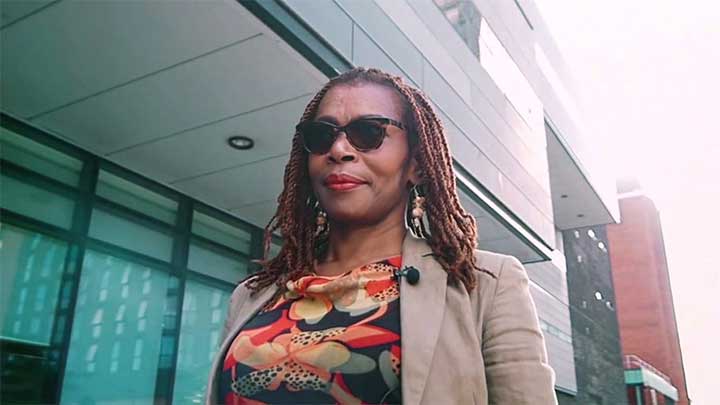
In 2025 we hosted the first Social Responsibility Conference, hosting Professor Erinma Bell as the keynote speaker. Professor Bell shared impactful insights into the importance of bridging social capital to build understanding and innovation between communities. She highlighted the importance of its role in transforming representation into agency to enable social change and communities to thrive.
Disability equality
Commissioned by the University of Manchester’s School of Medical Sciences (SMS) the bindweed project is a series of graffiti-styled stencils inspired by the plant bindweed and installed at three locations in the Stopford Building, which houses The University of Manchester’s Medical School.
This installation forces us to recognise how disabled experiences are often overlooked when they are not visible and encourages us to think about how the pace of higher education settings often amplify this invisibility. The artwork was installed in three phases over six weeks with volunteer support in a guerrilla style to build intrigue. In the final installation, a QR code was revealed which links to resources and support networks for staff and students with unseen disabilities.
Last year, the School of Health Sciences achieved an NDEI (neurodiversity employers index) score of 62 out of 100 after completing the Autistica Neurodiversity and Inclusion Survey. This reflected our commitment to fostering a neuroinclusive workplace. Building on this progress, we have submitted the survey as a faculty this year to continue to become a more neuroinclusive faculty.
Dr Hamied Haroon received the Individual General Distinguished Achievement Award for his exceptional leadership in advancing disability inclusion.
As founder of the Universities’ Disabled Staff Network and the National Association of Disabled Staff Networks, his work has driven systemic change across Higher Education and Research, inspiring colleagues nationwide.
He also actively supports the Faculty by championing inclusive practices and advising on EDI initiatives.
Race equality
Decolonising the curriculum focuses on ensuring teaching is inclusive, representative, and accessible to all students. This includes using diverse perspectives in teaching materials, reflecting global experiences in health and science, and adopting inclusive language that avoids stereotypes and broad generalisations. It also encourages accessible teaching approaches, such as providing materials in different formats and supporting students with varying language needs.
Through these changes, the curriculum aims to create a more inclusive learning environment where all students can engage meaningfully and see themselves reflected in their studies.
General Practice placements provide students with valuable exposure to diverse patient populations, including consultations conducted in languages other than English. To ensure meaningful learning in these settings, a structured approach was developed to support Clinical Placement Supervisors and students in navigating language barriers. This includes targeted training, reflective learning opportunities, and experiential sessions where students observe non-English consultations and explore the complexities of communication, culture, and care.
Now embedded within the Year 4 GP curriculum, this work enables students to better understand patient diversity and develop confidence in delivering inclusive, culturally responsive care.
The reverse mentoring scheme creates space for senior leaders to be mentored by staff or students from racially minoritised backgrounds. Through open and honest conversations, participants share lived experiences, challenge assumptions, and build understanding of structural inequalities. The programme supports cultural change by informing leadership practice and strengthening commitment to race equality across the Faculty.
Stories
Driving positive change in disability equality
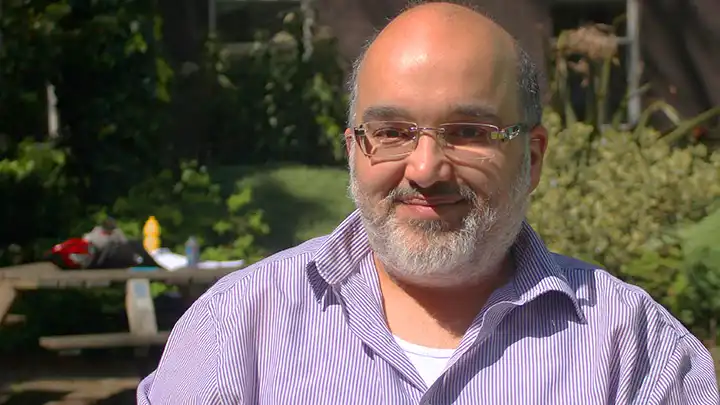
Postdoctoral Research Associate, Hamied Haroon has been at The University of Manchester for 20 years.
Read the story : Driving positive change in disability equality.
How exploring diversity can create unity
A new public engagement installation showcasing how creative arts can be used to communicate research was launched within the Manchester Museum’s South Asia Gallery to coincide with World Cancer Day 2025.

Tackling inequalities in mental health
People of African and Caribbean backgrounds, including those who identify as Black British and Mixed heritage, are significantly more likely to be diagnosed with schizophrenia and related psychoses than other ethnic groups in the UK, but the least likely to access psychological care.
Finding a voice
For those transitioning, having a voice that matches their gender identity is an important part of feeling comfortable and confident.

Policies and resources
Policies
- Download our Pay Gap Report 2025 (PDF, 1,402KB)
- Download our latest Equality, Diversity and Inclusion Policy (PDF, 68KB)
Resources
At the University
- Equality-based staff networks
- UOM Pay Gap infographic
- Athena SWAN (Faculty)
- Athena SWAN (University)
- Diversity Awards - Awards for equality, diversity and inclusion | The University of Manchester
External
Contact us
Get in touch with our team
If you have any queries concerning our equality, diversity and inclusion activities, policies or procedures, please contact us:
Email: SRBMH@manchester.ac.uk