
Collaborating with industry to research Alport syndrome
The Alport Research Hub is a pioneering initiative dedicated to advancing research and treatment for the rare genetic condition Alport syndrome. The Hub is funded by the Stoneygate Trust and Kidney Research UK.
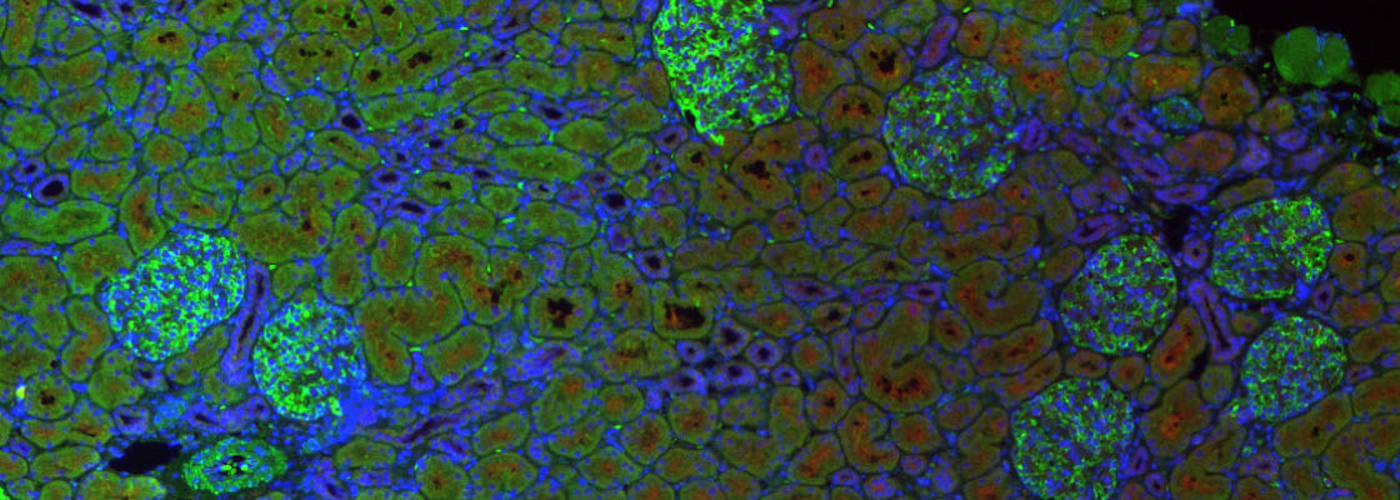
About Alport syndrome
- Affects kidney function, hearing health and the eye.
- Caused by variants in genes COL4A3, COL4A4 and COL4A5.
- 1 in 5,000 people are affected by Alport syndrome.
- Affected people will likely need a kidney transplant in their teenage years or early 20s.
- There is currently no cure; available treatments slow progression and manage symptoms.
Alport syndrome is a rare genetic kidney disorder characterised by the progressive loss of kidney function, hearing and eye abnormalities.
Aiming to bridge the gap between academic discovery and practical, impactful solutions for industry and patients, the Alport Research Hub has enabled a national collaborative research effort between The University of Manchester, University College London and The University of Edinburgh. It was launched in 2022 as a test case for similar hubs targeting other diseases.
An innovative approach
The Hub offers both physical and virtual platforms:
Physical hub
Based at The University of Manchester, the physical hub hosts experimental systems for Alport syndrome research, including human kidney organoids, zebrafish and mouse models.
These allow for high-throughput drug screening, advanced imaging and detailed analysis of basement membranes - the extracellular matrix structures that are affected in Alport syndrome.
Professor Rachel Lennon
Rachel is a Professor of Nephrology and Consultant Paediatric Nephrologist at The University of Manchester.
Virtual hub
The Hub's virtual platform enables access to patient data and samples, supporting clinical trial design and preclinical studies. This is achieved through collaborations with hospital sites across the UK and Genomics England, as well as the use of data linked to the National Registry of Rare Kidney Diseases (RaDAR), enabling research into the natural history of Alport syndrome.
The virtual hub also aims to perform whole genome sequencing in hundreds of individuals with Alport syndrome, potentially leading to increased diagnostic precision and targeted treatment options.
Industry collaborations
The Alport Research Hub was created thanks to a £2.55 million investment from Stoneygate Trust in partnership with charity Kidney Research UK. For patient involvement, the Hub collaborates closely with Alport UK.
To promote sustainability and resilience in funding streams, Hub director Professor Rachel Lennon and her team collaborate with a variety of industry partners, supporting studies through sponsored research agreements and collaborative projects.
Calliditas Therapeutics
Calliditas Therapeutics worked with the Hub by sending tissue samples from mice treated with an experimental therapy.
The Hub evaluated the efficacy of these treatments by analysing protein levels in kidney samples and by examining changes in kidney structure. The significant findings from these studies enabled the company to progress to a Phase 2a clinical trial in Europe.
Eloxx Pharmaceuticals
Eloxx Pharmaceuticals provided tissue samples from three patients who had received a drug designed to bypass genetic errors and enable partial production of the essential collagen IV protein, potentially extending kidney survival in individuals with Alport syndrome.
To assess the drug's effectiveness, Hub researchers performed mass spectrometry analysis on kidney biopsy samples. The team was particularly interested in detecting collagen IV alpha 3,4 and 5 chains, which are vital for proper kidney function.
Early results showed that the drug did indeed work, with new collagen protein expression confirmed. This study will now continue to recruit more individuals in the UK and USA.
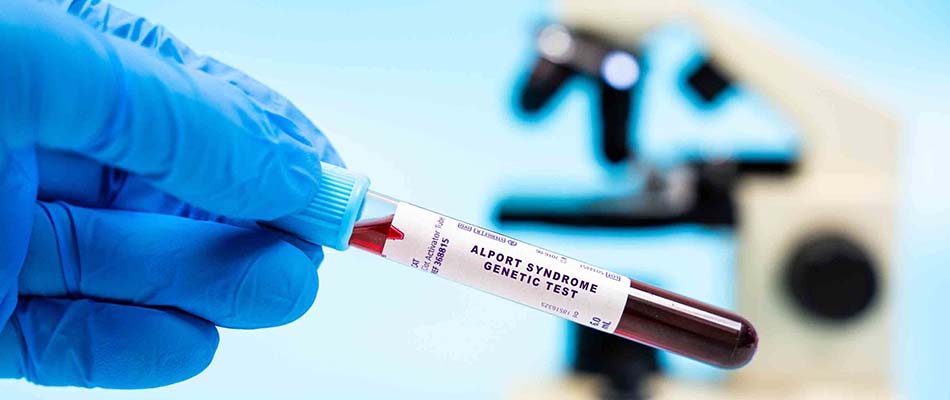
Deerfield: gene therapy in Alport syndrome
In this collaboration with Duke University, the team have been working on a gene therapy solution to treat Alport syndrome.
The project, which began in 2023, aims to design a mini gene to rescue the abnormal collagen protein in Alport syndrome. This involves overcoming challenges such as the large size of the collagen IV genes and ensuring the gene is delivered to the right place and cell type. Initial results from cells and the animal model C. elegans have been promising, showing that minigenes can be delivered, expressed, secreted and incorporated into basement membranes structures.
The research has now moved into mouse models, where the team is tracking the delivery of the minigene and secretion of new collagen in Alport mice. These experiments will test whether the gene therapy can rescue kidney function.
The collaboration has led to the filing of two patents and the creation of a new company to enable the project to continue.
Further industry collaborations
The Hub has also worked with other industry partners such as Novo Nordisk and has an ongoing project with Visterra Therapeutics. Through diversifying its income streams and collaborating with industry partners, the Alport Research Hub is growing from strength to strength.
Conclusion
The Alport Research Hub exemplifies how academic-industry collaboration can accelerate innovation in rare disease research.
By providing cutting-edge experimental systems, access to patient data and a platform for rigorous testing, the Hub bridges the gap between discovery and clinical application.
Its partnerships have led to new therapies, patents, clinical trials and commercial spin-outs, setting a model for future research hubs in other disease areas.

Spotlight on Professor Rachel Lennon, Director of Alport Research Hub
Rachel Lennon is Professor of Nephrology and Consultant Paediatric Nephrologist at The University of Manchester. She directs the Manchester Cell-Matrix Centre and the Stoneygate and Kidney Research UK Alport Research Hub, and co-directs the Wellcome 4-year Immunomatrix in Complex Disease PhD programme.
She also leads the Wellcome Discovery Research Platform for Cell-Matrix Biology and has supervised 17 PhD students. Her work bridges basic science, clinical care, and collaborations with patient organisations and industry to improve diagnosis and treatment.
How did you build your industry network to enable these collaborations?
Getting research out there through publications helped with the recognition of our expertise in Alport syndrome. Industry take notice of this and reach out.
The Hub offers a range of experimental systems and platforms that industry partners don't have access to. As Alport syndrome is a rare condition, these systems can't be 'off the shelf' and require specialised knowledge, which industry partners need for pre-clinical studies.
Often, industry partners approach us for input on interpretation of their own data and to provide advice on the next steps of their research. This strengthens and develops the relationship further, leading to more collaborations.
How has working with industry helped the Hub to grow?
From Stoneygate's initial investment, the Hub has returned it 1.8-fold through industry funding. This has boosted Stoneygate's commitment to the Hub, and it is now considering an extension of the funding.
In the three years since opening, we have brought in £3 million in additional investment and worked with 15 companies. Industry funding has enabled a diversification of funding streams, which alleviates pressure on staff funding through research grants.
This has meant that the Hub has been able to keep hold of talented and capable researchers by varying their workload between industry and central hub projects.
What benefits have you found professionally from working with industry?
Collaborating with industry brings in different perspectives and opinions on how to prioritise experiments. It's important to understand that we work with industry, not against them, as our goals are the same.
Our industry partners attend our patient workshops, which bring together patients, researchers, clinicians and industry. These workshops provide industry partners with the opportunity to hear directly from patients, providing a greater understanding of their experience.
I've learned that good communication is essential, so we deliberately set up regular meetings for company projects to check on progress. This allows us to come to a mutual understanding if there is a difference of opinion.
Industry partners can also encourage you to view the research in a different way, such as thinking about how many people would be impacted with one treatment over another.
What's the long-term goal for your research?
We want to transform care for patients with Alport syndrome. Through genetic testing at birth or early life, we can ensure specialist treatment much earlier, leading to personalised therapies before damage starts to occur.
Currently, there is no FDA-approved treatment for Alport, but through the work of the Hub and our collective collaborations, we expect there to be in the next five years.
Learn more about the Alport Research Hub and how to get in touch about a potential industry collaboration.